Nail Manufacturing: The Basics Explained
Nails are among the most widely used fasteners in the world, essential for construction, furniture, packaging, and countless other applications. Behind every nail lies a precise manufacturing process that ensures strength, consistency, and cost-efficiency.
Nail manufacturing is a high-speed industrial process that transforms steel wire into finished nails in a matter of seconds. Modern nail factories use automated machinery to cut, shape, and process nails with extreme precision, allowing manufacturers to produce thousands of nails per minute while maintaining consistent quality.
Understanding the basic nail production process helps manufacturers optimise efficiency, reduce waste, and ensure reliable output.
In this guide, we explain how nails are manufactured, the key stages of the process, and the equipment used in modern nail factories. We’ll also explore what happens after production, and why nail manufacturing is a smart business opportunity.
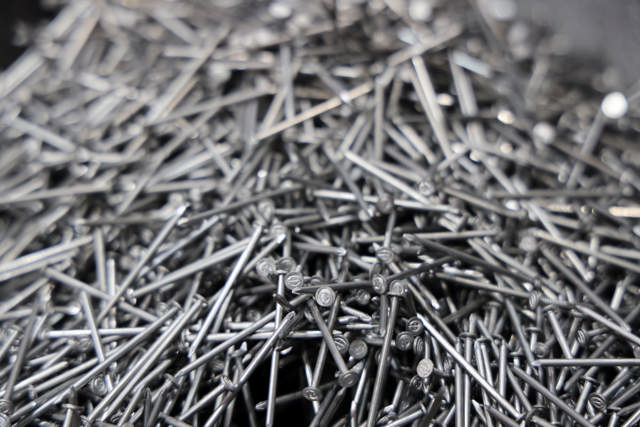
Why Nail Manufacturing Matters
The global demand for nails is enormous and steady. From housing projects to industrial packaging, nails are indispensable. This makes nail manufacturing a stable, high-volume industry with strong growth potential—especially for businesses that invest in efficient, modern production technology.
Quick Overview: The Nail Manufacturing Process
Nail production begins with steel wire and involves several key steps:
- Wire Preparation
Nails start as steel wire drawn from large coils. The wire is fed into the machine and straightened. - Pointing and Shank Formation
The wire is clipped to the required length, creating the shank and forming a point for easy penetration into materials. There are various point types, used for different applications. - Heading
One end of the wire is compressed to form the nail head, ensuring secure fastening. There are various head types, used for different applications.
Modern machines, such as ENKOTEC’s rotary nail manufacturing machines, perform these steps with high precision and speed, and can produce thousands of nails per minute whilst ensuring consistent quality and minimal waste.
What Happens After Manufacturing?
Once nails are produced, they often undergo secondary processes to meet specific application needs:
- Packaging
Nails are automatically packed into boxes or bags, directly from the nail machine or thread roller. - Thread Rolling
Nails can be thread-rolled to create screw-like threads for enhanced grip in wood or other materials. This is common for specialised nails used in construction or palletising. - Collating
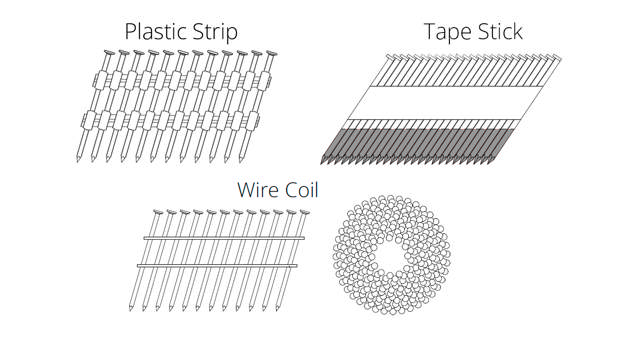
Nails are frequently collated into strips or coils for use in automated nail guns. Collation improves efficiency on job sites and is essential for high-volume applications such as roofing or framing.
These additional steps add value and versatility, making nails suitable for a wide range of industries and tools. Learn more about different nail types here:
Why Do Businesses Enter Nail Manufacturing?
Nail manufacturing attracts companies for several practical reasons:
- Consistent Market Demand: Nails are indispensable in construction, furniture, and packaging industries worldwide. This demand remains steady, making nail production a reliable addition to any portfolio.
- Scalable Operations: Modern nail machines enable manufacturers to produce millions of nails daily, allowing businesses to scale quickly and meet large orders efficiently.
- Operational Efficiency: Advanced technology reduces operating costs, minimises scrap, and maximises output—helping businesses improve margins and profitability.
- Strategic Expansion:
For companies already producing steel wire, nail manufacturing is a natural next step—transforming raw material into a finished product adds value and strengthens market position.
Similarly, businesses in pallet or wooden packaging production often choose nail manufacturing to gain control over their supply chain, ensuring consistent quality and reducing reliance on external suppliers.
The ENKOTEC Advantage
ENKOTEC’s rotary nail manufacturing machines are designed for:
- High-Speed Output: Up to 2,500 nails per minute.
- Compact Footprint: Save space and optimise factory layout.
- Oil-Free Operation: Cleaner, sustainable production.
- Consistent Quality: Every nail meets strict specifications.
Conclusion
Nail manufacturing is more than a basic process—it’s a cornerstone of global industry. With the right technology and approach, it offers long-term profitability, scalability, and sustainability. For businesses looking to enter or expand in this market, ENKOTEC provides the most advanced solutions available.
Want to learn more? Get in touch to start a dialogue with us.